

Overview
Regular performance management sessions — commonly known as "Stats" — are held between the Mayor's Senior Team, the Office of Performance & Innovation (OPI), and agency leadership to discuss performance, identify problems, diagnose causes, and direct resources to solve them. Staff from BBMR, the Department of Human Resources, and BCIT also participate. Meetings are either agency-focused or topic-focused around a Mayoral priority, and can include multiple agencies — from PoliceStat, FireStat, and BCITStat to priority- and operations-focused sessions like DowntownStat, ProcurementStat, and Grants ManagementStat.
Service-Level Performance Measures
Agency services track a family of measures that tell the story of How Much the service performed, How Well service delivery was executed, and whether anyone was Better Off. These measures were originally established for the Fiscal 2011 and 2012 budgets, and were integrated with the City's performance plan process in Fiscal 2025. Four types of measures are tracked; the table below gives examples from Service 609: Emergency Medical Services.
| Type | Description | Example for Service 609: Emergency Medical Services |
|---|---|---|
| Output | Amount of service delivered | # of EMS responses |
| Efficiency | Cost per unit of output | % of EMS fees collected |
| Effectiveness | Meets service standards | % responses within 9 min |
| Outcome | Benefit to the customer | % surviving cardiac arrest |
Agency Performance Plans
An Agency Performance Plan identifies an agency's goals, the actions to reach them, and how progress is measured, aligned to the Mayor's Action Plan. Current plans run September 30, 2026 – December 2028; goals and KPIs stay fixed for that period, while targets and initiatives update annually.
Hierarchical Alignment
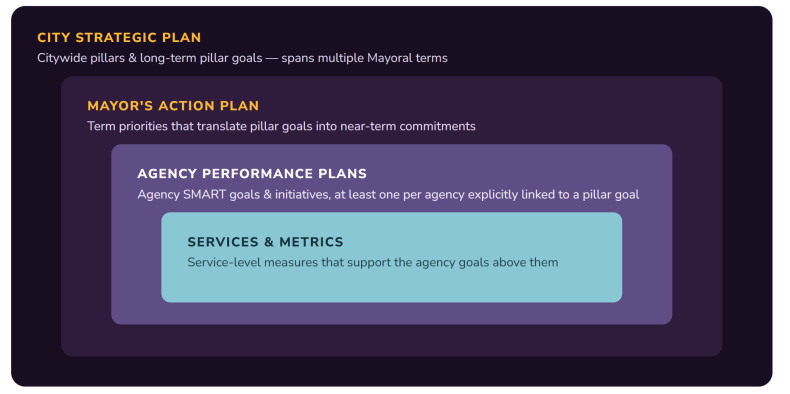
Nothing in a plan stands alone — every level nests inside, and is justified by, the level above it. Agency goals must ladder up to the Mayor's Action Plan; the Action Plan advances the City's Strategic Plan pillars; and service-level metrics exist to explain progress on the agency goals they sit under.
| Hierarchical Alignment | Description |
|---|---|
| City Strategic Plan | Citywide pillars and long-term goals - spans the current Mayoral term |
| Mayor's Action Plan | Term priorities that translate pillar goals into near-term commitments |
| Agency Performance Plan | Agency SMART goals and initiatives, at least one per agency explicitly linked to a pillar goal |
| Services and Metrics | Service-level measures that support the agency goals above them |
| Plan Components | Description |
|---|---|
| Overview & Vision | Why the agency exists and the future state it's working toward, linked to the Mayor's Action Plan |
| Services | Service name, description, and service-level metrics with baselines & targets |
| Goals, Initiatives & KPIs | 2–5 SMART goals, each with FY27 initiatives, KPIs, and a link to a City Pillar Goal |
| Plan Stewards | Named owners responsible for data quality and reporting |
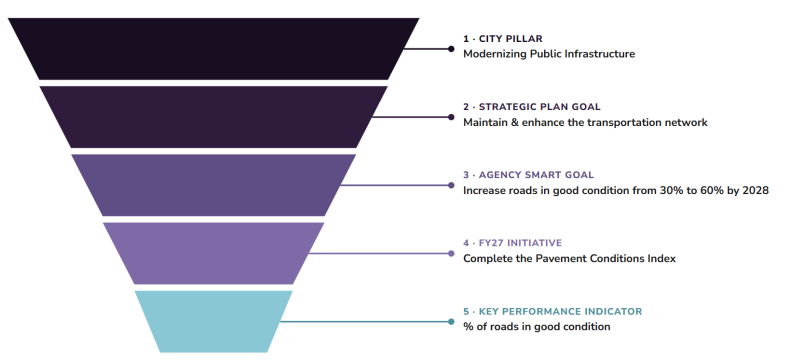
Goal Ladder
Every SMART goal should trace one continuous line from City strategy down to a named, accountable person. SMART (Specific, Measurable, Achievable, Relevant, Timebound).
Worked Example — MONSE
The Mayor's Office of Neighborhood Safety and Engagement plan (v1.3) shows what a completed plan looks like in practice.
| GOAL | Sustain Effectiveness of Violence Intervention Models |
|---|---|
| Goal | Sustain a 15% YoY reduction in Homicides and Shootings by Dec 31, 2028 |
| Pillar Goal | 1.1 Disrupt Violent Networks, Stop Gun Trafficking, and Break the Cycle of Repeat Offending |
| Initiative | Scale the Group Violence Reduction Strategy (GVRS) to two more districts |
| KPI | Citywide Violence Reduction — baseline -13.13%, target 15% YoY reduction (CitiStat/BPD, daily) |
| Type | Outcome |