Revitalizing the Arts in Baltimore:
How ARPA Funds Are Strengthening the Arts Community
After facing unprecedented shutdowns, layoffs, and financial losses, Baltimore’s arts sector is experiencing a remarkable resurgence, fueled by the support of American Rescue Plan Act funding, reinforced by partnerships with local nonprofits, and amplified by the resilience and creativity of Baltimore's artists.
The COVID-19 pandemic had a significant impact on the arts, closing venues and halting performances, which threatened many art organizations. According to COVID-19 Pandemic Impact on The Arts research[1] by Americans for the Arts, nonprofit arts and culture groups in the U.S. faced about $16.3 billion in losses from canceled events, leading to a $16.6 billion drop in local business spending. This decline resulted in a $5.6 billion loss in government revenue and affected 959,000 jobs.
Popular art institutions like museums and performing arts centers faced significant challenges due to the pandemic. Nearly half of arts organizations laid off or furloughed staff, with recovery expected to take years. The performing arts sectors experienced unemployment rates as high as 45.6%, and Black, Indigenous, and people of color artists faced significant difficulties, with unemployment rates of 69%, resulting in a substantial loss of 61% in creative income.
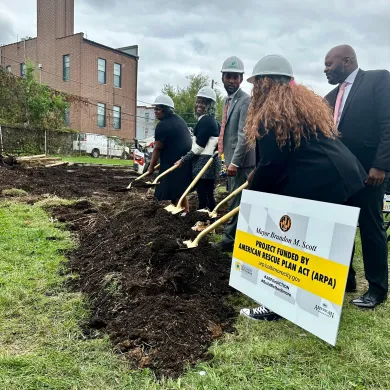
In April, Mayor Brandon M. Scott announced 28 recipients of the $3.6 million Diversity in Arts Grant. The grant, made possible with American Rescue Plan Act (ARPA) funds, is part of a $6.25 million investment announced in September 2023, which focused on supporting arts and cultural institutions. As of October 2024, a total of $8.2 million in ARPA funding has been committed to revitalizing the arts in Baltimore City.
The Diversity in Arts Grant, administered by the United Way of Central Maryland, will help awardees sustain and expand their work. The awarded institutions are implementing arts-based programs, including after-school opportunities, summer camps, visual and performing arts exhibitions, music festivals, and community art installations.
This ARPA Insights article highlights the program’s administrator and three grantees: the American Institute of Architects, Baltimore Chapter; the Marching Elite Foundation; and Beats Not Bullets.
Franklyn Baker | President and Chief Executive Officer | United Way of Central Maryland
“United Way of Central Maryland (United Way) is honored to have the opportunity to support the Mayor’s Office of Recovery Programs by administering the 2024 ARPA Community Arts Grant program. Through an open and competitive process which saw more than 90 applications, 28 arts and culture organizations were selected to receive funding.
We have had the opportunity to hear directly from these community partners about how important and valuable the ARPA funding has been to their efforts to sustain and expand the work they do to provide high-quality art and cultural experiences and activities that are accessible to all Baltimore City residents, especially underrepresented and marginalized communities.
Through the first six months of implementation, ARPA funding has helped local arts and culture organizations create more than 400 opportunities (exhibits, performances, and classes) that have been enjoyed by over 32,000 people.”
Lauren Bostic Hill | Executive Director | American Institute of Architects, Baltimore Chapter
American Institute of Architects (AIA), Baltimore Chapter inspires and empowers architects and designers throughout the Baltimore region to engage with communities to improve society and transform the world through the built environment. AIA drives positive change through the power of design, focused activism, and public outreach by encouraging awareness and knowledge of architecture in Baltimore. The AIA, Baltimore Chapter, received an ARPA grant totaling $14,560.
“ARPA funding has helped us maintain our staff and continue our programming. It's helped us to be able to return to the architectural tours that we do for the public, including our biggest event, which is Doors Open in Baltimore, and it's an annual event that we've been doing. This was our 11th year. Obviously, because of the pandemic, we had to put it on pause. We did it virtually, but with ARPA funding, we were able to return to an in-person version of it and provide tours.
This year, during the last weekend of October, we opened up over 40 sites throughout the City to the public so almost 1,000 Baltimoreans could visit and explore places that they may not have known about otherwise. So, it exposes people to the architectural history of Baltimore City, giving participants an overall understanding of the culture in the City. places that they may not have known about otherwise. So, it exposes people to the architectural history of Baltimore City, giving participants an overall understanding of the culture in the City.
We couldn’t have gotten this done without ARPA funding because, although we have a lot of volunteers, ARPA funding helps to support AIA staff, and we can occasionally contract some people to take photos and document the event. So we've been able to kind of spend a little bit of time to reimagine how the program used to be and do some things a little differently this year, and we wouldn't have been able to do that without additional funding.”
Dennis Lee | Executive Director | The Marching Elite Foundation
The Baltimore Marching Elite Foundation is a nonprofit organization based in Baltimore, Maryland, focused on youth development through music and the marching arts. It offers programs that teach discipline, teamwork, and leadership skills using the structure and creativity of marching band activities. The foundation is committed to empowering young people from diverse backgrounds to thrive musically and personally while fostering community cultural awareness and artistic expression. The Marching Elite Foundation received an ARPA grant totaling $36,300.
“The Diversity in Arts grant has allowed us to expand our youth wood and brass sections. We weren’t actively recruiting for those areas, but once the funding came in, we were able to open those sections up to more youths. This funding has also helped us go younger to create our feeder program; we will start at (age) 8 and go to 12. Our goal was 40 kids, but we have easily brought in 80 kids using the funding. ARPA funding has helped us exceed our goal.
When COVID-19 hit, the parents were afraid the kids weren't coming out. They shut the schools down, and so we still had a hardcore collective few, but with social distancing and the schools being closed, it became really hard. We would not have as many students and instruments as we have without this funding. And it isn’t just the funding. The publicity we have gotten because of this announcement around this funding has allowed us to raise more money to support the program!”
Kelly Nolan | Program Director/Parent | The Marching Elite Foundation
“In today's generation, it's easy for kids to get sidetracked and to get into a whole bunch of different things, so having them here four days a week is a huge, huge benefit. The benefits that they get, the joy that you see on their face, you can turn around and see all the youth that's behind them they're all smiling, and they're playing, but also when they perform, and they know they did a good job afterward how they look that makes you feel good.”
Kevin Beasly | Program Director | Dream Bigger Community Institute | Beats Not Bullets
The "Beats Not Bullets" program is a music education initiative that engages at-risk youth in Baltimore City. It teaches participants critical skills such as songwriting, music production, audio engineering, and the music business. The program aims to provide a creative and safe outlet, fostering personal and professional growth while steering youth away from violence. Dream Bigger Community Institute received an ARPA grant totaling $43,000.
“We rely on grants. We rely on any funding that we can apply for and any funding that may come find us. The ARPA funding that we did receive has been very beneficial to making sure that our jail program continues. We've been going [in]to jail since November of 2022. We call it ‘Beats Not Bullets Behind the Fence.’
ARPA funding also let us start a new program called ‘Musical Expressions with Friends,’ which pretty much took the concept of Beats Not Bullets and packaged it for children with autism and special needs. So that program probably wouldn't be running currently if we didn't receive that funding, honestly. So that's a blessing for sure.
Our Saturday Beats Not Bullets program is also attached to that funding; the age range is probably 12 to 17. Currently, we serve over 75 students and their families, and we plan to serve over 100 participants in the Beats Not Bullets Behind the Fence program.
But as far as the impact on the children, having these programs is the real impact because they have something to do tomorrow morning for a good four hours or so: get to eat, get to make music. And like I said, the mentorship piece is there; that's what it's really about.
The pandemic impacted all of our programming for sure. The pandemic literally shut us down overnight, and we were in mid-program, and the children didn't know what was really about to happen, no one did, but I remember them saying, ‘Hey, we got to shut down the program.’ We were down probably for like a full year. And then even personally, that was a very rough year for me. If we hadn't received this funding, there are certain programs that would not be currently active. If we did not receive that funding, then Musical Expression with Friends definitely would not be running right now.”
Brenden | Student/Program Participant | Beats Not Bullets
“Beats Not Bullets literally gave me my voice back. I don't know where I would be today if I wasn't in the program.”
Jalyn | Student/Program Participant | Beats Not Bullets
“Beats Not Bullets gives me a place to be creative and get better at my craft. Mr. Kevin really treats us like his own children.”
Nicholas Wisniewski | Co-Founder | C O M P O U N D
The Compound is a nonprofit artist-run residence, studio, and event space in the East Baltimore Midway neighborhood. The building was previously home to the S.W. Betz forklift factory before it sat vacant for a number of years. Baltimore artists Nicholas Wisniewski and Marlon Ziello purchased the property in 2010 and, in collaboration with others, transformed it over the years into the space it is today. The Compound encompasses multiple buildings, including studio space, an event space, a wood shop, a recording studio, and four row houses for the community of artists living and working there. The Compound received an ARPA grant totaling $100,000.
“While [COMPOUND has] been very successful in raising capital funds to support the renovation of our facilities, it has been challenging for us historically to access operational grants and support. However, this grant was a game changer. The ARPA grant was the second-ever operational grant we have received. ARPA funds have been instrumental in our organization's growth, allowing us to build capacity by hiring new staff and broadening our programming. These paid positions have taken the Compound to a higher and more detailed level of organization and production.
With this new funding, we have been able to increase the caliber and frequency of our public programming and the payments to artists involved with the productions.
In 2024, we have programmed 37 community events with live music and performances. We will host two more before the end of the year. We welcomed 4,800 people into our venue and related public spaces for these concerts. This is a major achievement for the Compound, and we aim to maintain or grow this activity in 2025.
We are also in the process of developing a new artist-in-residence program, launching in 2025, and growing our multidisciplinary arts program to curate 2-3 exhibitions featuring multiple artists from both the Compound community and outside of it each year. We would not have had the capacity to achieve these goals without support from ARPA.”
Laurel Levia | Performing Arts Manager | C O M P O U N D
“There is no place like the Compound as a venue. It helps the community because it expands our community! In a city with such liminal and limited space for arts and music to flourish, the Compound is a place that brings people together and allows for underground music culture to be sustained rather than forgotten.
A lot of my thoughts have to do with the history of how the city and the music and arts scene have changed so much in the last 20 years. Being from Baltimore, I've seen the city as a place where the arts have flourished and gone through so many adaptations as our arts spaces have gradually decreased over the years. The Compound is one of the last few spaces that bridges the gap between being a legitimate venue and a community space.
The Compound also makes it possible and more promising for artists to develop real careers."
Continuing the Work | Investing in the Soul of Baltimore
“Baltimore has always been a City defined by the arts, and our art community remains a cornerstone of our City's identity, reflecting our history, diversity, and resilience. Baltimore’s arts community has always been there to express what this City is about, often giving a voice to the voiceless. However, public dollars have too often gone just to the big names and the big players in town. This investment, made possible through the American Rescue Plan Act, underscores our dedication to ensuring that all artists and communities, particularly those minority and historically underrepresented organizations, have equitable access to resources and opportunities,” said Mayor Brandon M. Scott.
As we emerge from this crisis, investing in local art organizations is more critical than ever. Supporting art institutions fosters creative recovery, strengthens community ties, drives economic growth, and ensures that art remains an accessible source of inspiration and resilience for all.
---------------
[1] COVID-19 Pandemic Impact on The Arts, https://www.artsactionfund.org/sites/artsactionfund.org/files/COVID-19%20Pandemic%20Impact%20on%20the%20Arts%20Research%20Update%20%204-26-2021.pdf